



Adopting artificial intelligence ethically in a business means putting technology at the service of human growth and the common good, not just cost-cutting. Artificial intelligence already shapes how we quote, reconcile payments, design campaigns, and make decisions. For those of us who lead a business, the real question is no longer whether we will adopt it, but with what purpose and in whose service.
That was the central theme of the conference “Vulnerable Humanity Facing AI: The Challenges of Its Ethical Application,” delivered by Marcial Quintanar to the Asociación Empresarial Guadalupana. Throughout his talk, Quintanar invited business leaders to move past both fear and naive enthusiasm, opening an honest reflection on our role in guiding this technology toward the growth of people and organizations.
Drawing from his ideas, we gathered the ethical challenges, dilemmas, criteria, and practical opportunities that artificial intelligence opens for companies looking to grow solidly without losing sight of their people.
Why is artificial intelligence an unprecedented shift for businesses?
Artificial intelligence marks a turning point because, for the first time, companies work alongside tools capable of surpassing human cognitive capacity across multiple tasks and even training other systems in complex simulations. The real competition is no longer between humans and machines, but between people and companies that use AI well and those that still do not.
The figures Quintanar shared illustrate the speed of this transformation:
- According to the World Economic Forum, AI will displace roughly 92 million jobs while creating nearly 170 million new ones, an estimated net gain of 78 million jobs.
- One-quarter of jobs already have potential exposure to AI. Virtually no trade is untouched—from administrative and creative work to sectors many thought were immune, such as restaurants, bakeries, plumbing, landscaping, and masonry.
- 88% of organizations already report active use of artificial intelligence.
- Electricity demand from data centers is projected to double between 2025 and 2030.
In the face of this shift, it helps to strip technology of any magical aura. As the speaker emphasized, AI does not act on its own: behind it there are always people who design it, train it, and decide how to apply it.
That shakes the foundations of how we understand daily work. Showing up on schedule or repeating processes a tool can finish in minutes is no longer enough. The urgent question for every professional and every sales or operations team is straightforward: what is the human value that I bring?
Between naive hope and paralysis
Faced with technological change of this scale, two responses tend to paralyze organizations: the naive hope that everything will sort itself out on its own, and the victim mindset that the future belongs only to a powerful few. Overcoming both extremes requires an adult, active, and responsible business stance.
Quintanar urged leaders to step out of both traps. Halfway through his talk, he even proposed flipping the title of his own conference: moving from seeing ourselves as a vulnerable humanity merely trying to defend itself, to asking what we are going to do with the enormous power now in our hands to improve people’s lives and leave a better world.
What are the five ethical risks of AI that no business can ignore?
The five primary risks of adopting artificial intelligence without ethical judgment are weakening critical thinking, reducing people to a cost, concentrating power and wealth, eroding public trust, and advancing faster than ethics and regulation. Facing them squarely is the first step to preventing efficiency from destroying human value.
- Smarter machines and people less capable of thinking for themselves. Universities are already debating how to integrate AI without dulling critical thinking, while several countries restrict screens and phones after seeing that, when misused, they numb the capacity for reflection.
- Viewing people as a cost to cut. For decades it became easy to speak of people solely as “labor” or “resources.” AI can deepen that mindset if it is used only to trim payroll, forgetting that we work with human beings capable of creating, innovating, and standing in solidarity.
- Concentration of power and wealth in very few hands. The intense race between U.S. and Chinese models to lead the future of AI reveals how much economic and strategic power is at stake, along with the risk that its benefits remain concentrated among a few.
- Loss of trust and difficulty distinguishing truth. Synthetic videos, voices, and content make it increasingly hard to tell what is real, weakening freedom of choice and putting strain on already fragile societies and democracies.
- Technological power moving faster than our ethics and regulation. Artificial intelligence advances exponentially, while applied ethics and regulatory frameworks lag far behind, with no global body able to govern it responsibly.
What opportunities does AI open when placed at the service of people?
When guided well, artificial intelligence frees teams from repetitive tasks so they can deploy their talent, restore purpose to work, expand access to healthcare and education, and help regenerate the environment. The very technology that causes concern today can multiply the positive impact of businesses and society.
- Discovering, cultivating, and deploying our best talents. By delegating repetitive, low-value tasks to AI, people gain space to focus on judgment, creativity, and human relationships—the areas where they truly add value.
- Putting each person’s best at the service of the common good. Work stops being a draining bureaucratic routine and becomes a space to contribute with purpose.
- Healthcare within reach of many more people. AI accelerates research, diagnostics, medicines, and medical solutions that can bring healthcare closer to millions.
- Inclusion and democratic access to learning. Someone in a remote location can now access top-tier knowledge and training that used to be reserved for a privileged few.
- Caring for the environment and regenerating life. Technological innovation can help manage natural resources more wisely, address crises such as water scarcity, and regenerate ecosystems.
Two possible scenarios for the future with AI
The future of artificial intelligence does not depend on the algorithm, but on the direction chosen by those who lead it: using it solely to squeeze efficiency or placing it at the service of human development. Quintanar outlined these two paths clearly:
- AI solely at the service of efficiency: people growing ever more dependent on technology—like families sitting around a dinner table staring at their phones instead of enjoying the meal and conversation—workers treated as replaceable, concentrated power and wealth, distrust, and growing exploitation of resources.
- AI at the service of people: human potential unleashed as never before, shared capabilities and opportunities, critical thinking, responsibility, and innovation placed at the service of life.
The same technological breakthrough can push either of these two futures. The difference does not lie in the tool, but in the concrete decisions we make every day.
The human being as a perfectible perfecter
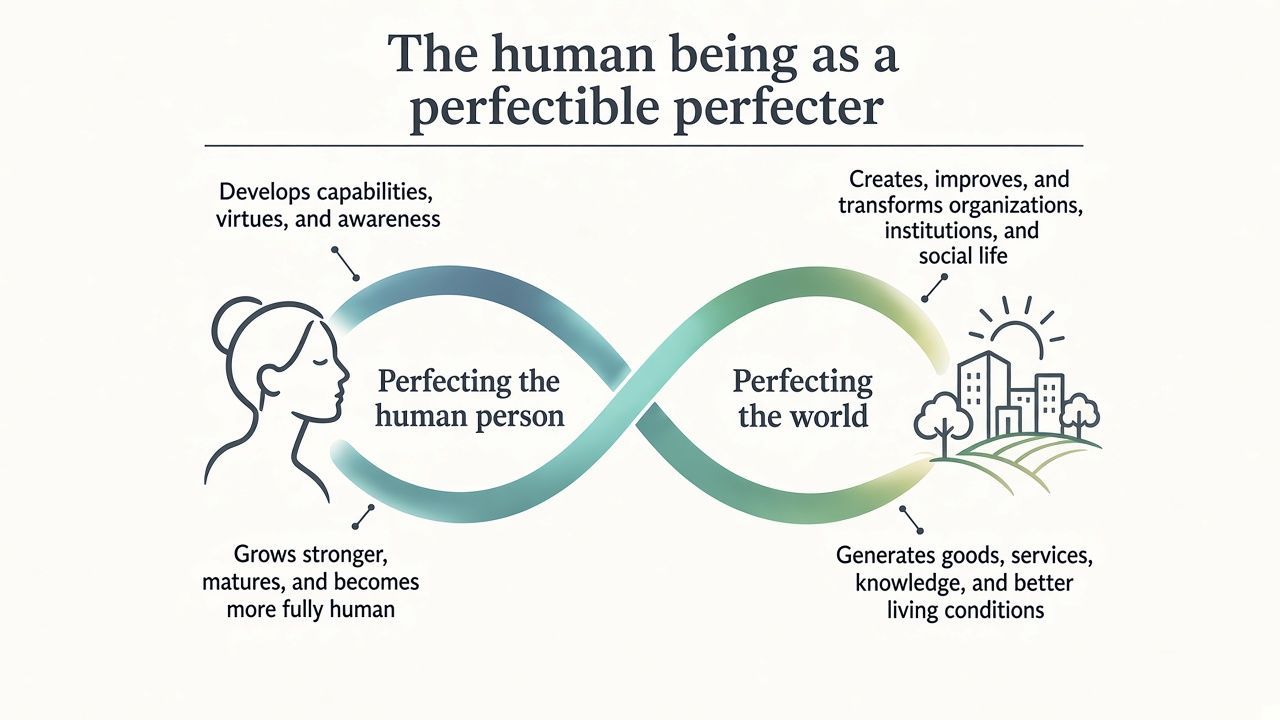
The human being is a perfectible perfecter: by developing our capabilities we create better goods, services, and living conditions, and that very process transforms and strengthens us from within. Quintanar drew this concept from Spanish philosopher Leonardo Polo—which he explored and deepened with the help of AI—to explain why the human person must remain at the center of all innovation.
We are not perfect, yet we can always grow. When a person grows, they create better solutions for their company and community. And by improving their environment, organizations, and social life, that same person matures and becomes more fully human. It is a continuous cycle: by perfecting ourselves, we perfect the world; and by improving the world, we continue to perfect ourselves.
Quintanar illustrated this with Michelangelo’s Pietà in St. Peter’s Basilica: the sculpture is the visible fruit, yet during the process of creating it something also changed inside the artist, leaving him better prepared for his next work.
The opposite is also true: without growth, there is degradation. There is no neutral ground. As one attendee noted during the Q&A, when technology accompanies social decline, the problem does not come from the tool, but from the deterioration of the person using it. That is why the answer is not to halt technology, but to better form the people who use it.
What is the business leader’s role in the age of AI?
The business leader’s role in the face of AI is to embrace the company as a space for human transformation and integrate two inseparable outcomes in every project: visible economic results and the inner growth of the people who make them possible. This is the most practical takeaway from the talk for anyone running a business.
1. Changing how we view the company
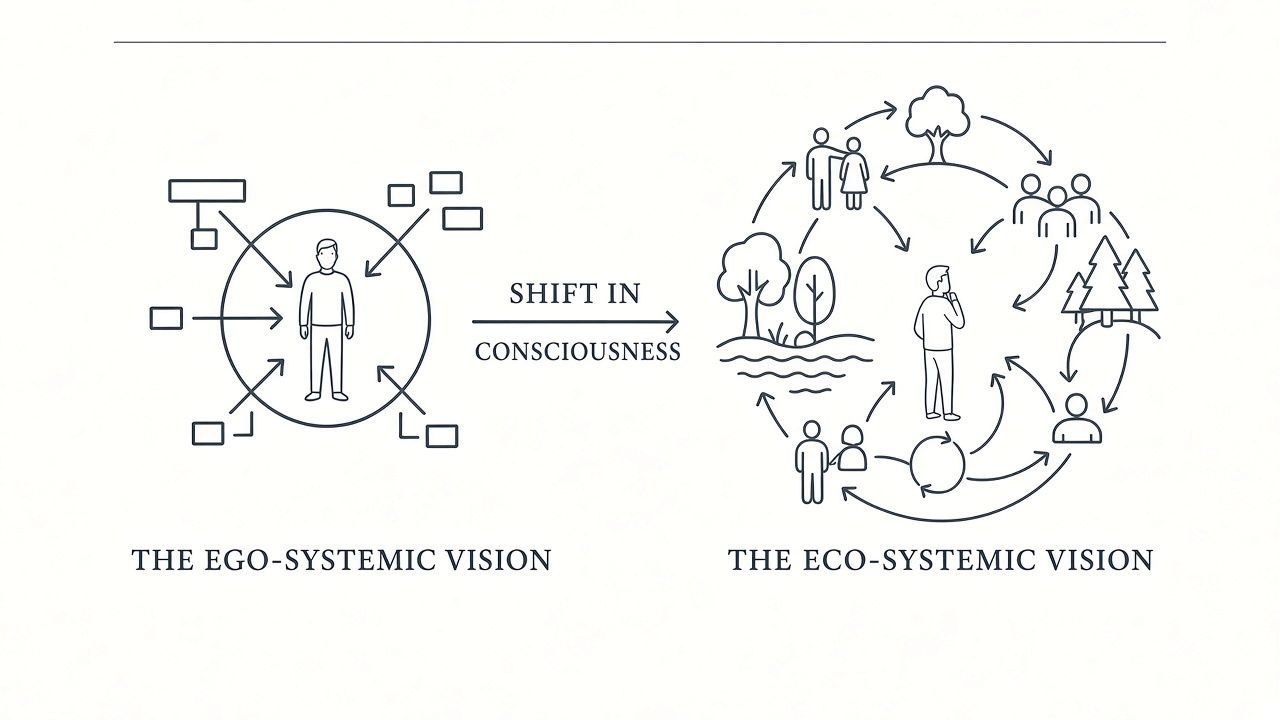
This means stopping the habit of seeing the company as a victim of the market or technology—and also rejecting the narrative that a business exists only to extract resources and make money. Universities, government, and civil society each play a role, but the business is a privileged space for transformation because every day it brings together people with different backgrounds and talents to collaborate toward a shared goal. Well led, a company becomes a school of collaboration, solidarity, and human growth.
2. Integrating the two fruits of work
A business produces goods and services to be profitable; that is real and necessary. At the same time, it is a community of life and work. Separating those two sides breaks its meaning. Every project—including any AI project—produces two fruits we must care for equally:
- The visible fruit: the products, services, savings, sales, and solutions we deliver to the market.
- The inner fruit: the growth, learning, and dignity of the people who make them possible.
As Quintanar summed it up in a phrase worth keeping: “It is about doing business by doing good, not making money so we can do good later.”
How should you evaluate an AI project before implementing it in your company?
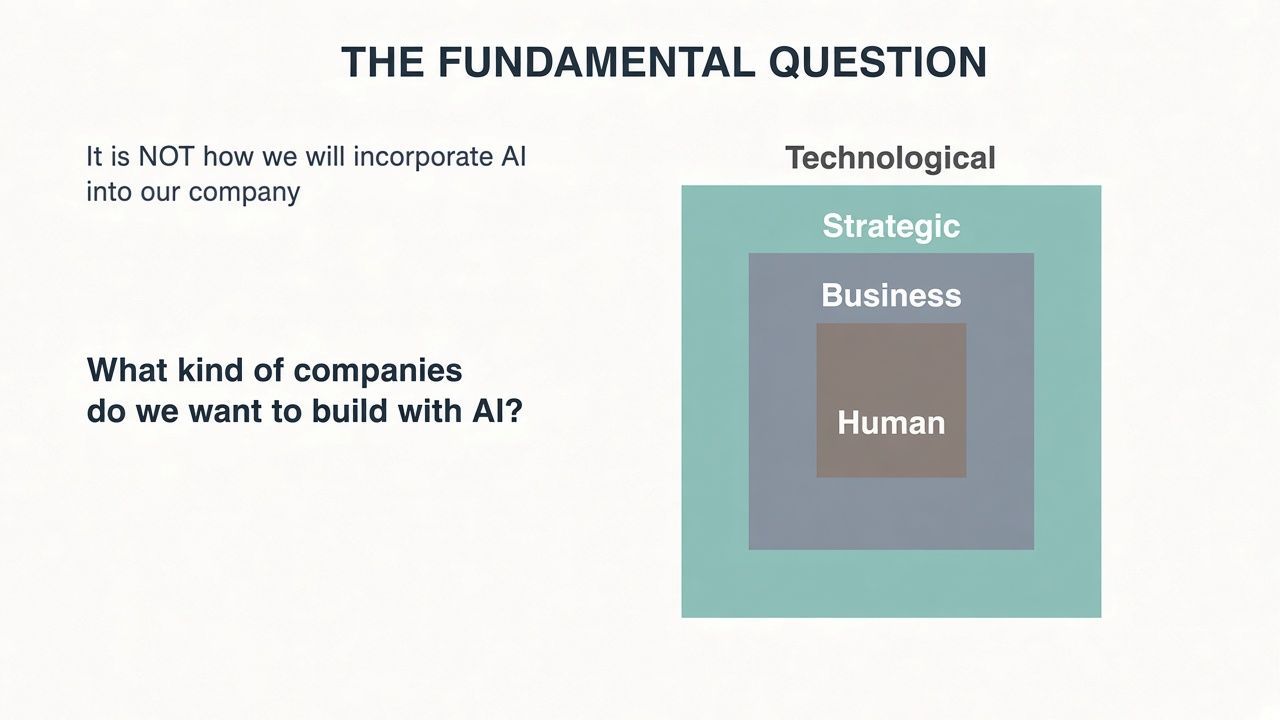
Before approving an automation or artificial intelligence tool, evaluate it across four dimensions: desirability, viability, feasibility, and impact on people and the ecosystem. Measuring these four variables before buying technology prevents rolling out solutions that promise quick savings while damaging your team or commercial operation.
- Desirability: does it genuinely solve a need, and do the people involved want it?
- Viability: is it economically sustainable?
- Feasibility: do we have the technical and operational capacity to execute it?
- Impact and ecosystem: how does it improve people, the company, and its surrounding environment?
The fourth dimension is usually the missing piece. No initiative can claim to be well designed if it is extractive toward its community or its own people.
Something very similar happens in sales and marketing: many companies buy AI tools or generate more leads without first checking whether their strategy, processes, and team skills are ready to make use of them. That is why at WSI Plokus we run our Commercial Strengthening Program on the principle of measuring before intervening and diagnosing before prescribing : before adding technology, we pinpoint what is holding back the commercial system and how to elevate the real capabilities of the people who sell.
The real dilemma: “Savings have a first and last name”
To ground these four dimensions in reality, Quintanar presented a concrete case: a distributor in Guadalajara pilots an AI agent that captures invoices, reconciles payments, and follows up on collections. The pilot works so well that the monthly close drops from eight days to two. The projected savings equal six of the nine roles in the department, which could now run with three people. Four of those employees have been with the company for over 15 years, and two are close to retirement. Then the board asks the CEO: “When are we going to see the savings?”
There is no automatic formula for that dilemma, and that is precisely where ethical leadership is tested. Technology has already shown what it can do; what defines a company is how it chooses to navigate the transition, how it reskills talent, how it shares value, and how it treats the people who built the organization.
The future of work and five ethical criteria for decision-making
Looking toward 2030, the debate over automation and universal basic income challenges companies to design purposeful work and make decisions guided by five ethical criteria that always put human dignity first. A basic income without purpose could lead to people who are financially sustained, entertained, and dependent—or it could open the door to a society of creators freed from the anxiety of subsistence to think, create, and inspire.
From there, Quintanar left three open questions for every leader:
- How will we distribute wealth when producing it requires less grueling labor?
- How will we form people capable of exercising their freedom responsibly when working out of economic necessity is no longer unavoidable?
- How will we design organizations that remain spaces for human development and contribution to the common good?
Even today, one uncomfortable question is worth asking: in our company, how many people show up only for the paycheck? When someone merely “fills a job” instead of doing meaningful work, the person loses, the company loses, and society loses.
To keep our compass steady when making business and technology decisions, Quintanar shared five clear, firm ethical criteria:
- Technology must serve the human being, never the other way around.
- No machine can replace a person’s dignity, freedom, or conscience.
- It is up to us, acting ethically, to guide the design, development, and use of AI.
- Work must serve the person, not the person serve work.
- Leading and educating means forming people able to discern what is good and put their abilities at the service of others.
A change of era and an invitation to pause
Navigating a change of era requires taking an honest pause before reacting in haste, so we can decide whether to spend our energy propping up a declining model or building a more human and sustainable one. Many of the structures and habits that made our businesses successful in the past are no longer enough for today’s challenges.
Here, Quintanar recommended the book Active Hope by Joanna Macy and Chris Johnstone (subtitled How to Face the Mess We’re in Without Going Crazy ). One of its core ideas is that what moves us into action is not having everything figured out in advance, but seeing what is at stake and feeling called to play our part. The abilities and strengths we need are rarely discovered by locking ourselves away and doubting whether we are enough; they emerge when we step onto the path and act in community, leaving isolated individualism behind.
That is why his closing invitation was not to rush out and do more things, but to pause —in the spirit of Ignatius of Loyola in Manresa: to stop honestly, look at ourselves with fresh eyes, and ask two essential questions: what is life seeking to bring into existence through me? and what can our company contribute to leave a better world?
Frequently asked questions about ethical AI in business
What does it mean to apply artificial intelligence ethically in a business?
It means using AI to elevate people’s judgment, talent, and dignity while generating profitable results. Rather than viewing technology solely as a tool to cut payroll, the company cares equally for the visible business outcome and the inner growth of its team.
Will artificial intelligence eliminate more jobs than it creates?
According to World Economic Forum data cited by Marcial Quintanar, AI will displace roughly 92 million jobs while creating nearly 170 million new ones, an estimated net gain of 78 million. The challenge for each company is reskilling talent and redefining the human value of its teams.
What four dimensions should you evaluate before implementing AI in a business?
Before approving any tool or automation, evaluate four dimensions: desirability (whether it solves a real need), economic viability, technical and operational feasibility, and impact on people and the ecosystem. Weighing that fourth dimension prevents decisions that yield short-term savings while weakening the organization.
Why diagnose your commercial system before adding AI tools?
Because technology amplifies what already exists in your operation. When a company first evaluates its strategy, processes, and sales team competencies—as WSI Plokus does through its Commercial Strengthening Program —AI integrates to remove friction and multiply results instead of creating sales chaos.
How can a sales team leverage AI without losing the human touch?
By delegating repetitive tasks to AI—such as operational follow-up, data organization, and documentation—so people can spend more time listening to clients, exercising consultative judgment, and building relationships of trust that no machine can replace.
The opportunity is in our hands: the next step
Artificial intelligence does not decide whether a company becomes colder or more human. Those of us who lead it do—with every tool we choose to implement and with how we accompany our teams through the transition.
Today, businesses have a historic opportunity: to use AI to remove friction, streamline operations, and multiply results while freeing the judgment, creativity, and human connection that no machine can replace. Leaders who align strategy, clear processes, technology, and human development will build advantages far stronger and more lasting than any short-term cost cut.
If you want to evaluate where your commercial system stands today before investing in more technology or leads, explore our Commercial Strengthening Program, designed to align strategy, processes, and sales competencies with a people-centered approach. You can also schedule a video call with our team at WSI Plokus to explore how to adopt artificial intelligence strategically and profitably in your business.
About the conference and speaker
This article is based on the conference “Vulnerable Humanity Facing AI: The Challenges of Its Ethical Application,” delivered by Marcial Quintanar to the Asociación Empresarial Guadalupana.
Marcial Quintanar holds a degree in Public Accounting and Auditing from the Escuela Bancaria y Comercial de México and a degree in Philosophy from the Instituto de Filosofía de los Misioneros del Espíritu Santo in Guadalajara. He spent nine years leading staff training and development across different regions of Mexico and, from 1992 to 2007, worked as a business consultant helping executives strengthen talent and human growth in alignment with business strategy. He has collaborated with hundreds of business leaders through institutions such as Fundex, Coparmex, and ITESO, and has 40 years of involvement with the Unión Social de Empresarios de México (USEM), where he coordinates the Studies Committee in Guadalajara and collaborates with the USEM Confederation in updating and presenting Difoso. Since 2018, he has worked full time researching, sharing, and implementing new people-centered organizational models. He publishes his work at organizacioneshumanas.org and shares insights on LinkedIn as Marcial Quintanar .